Tuesday, 7 August 2018

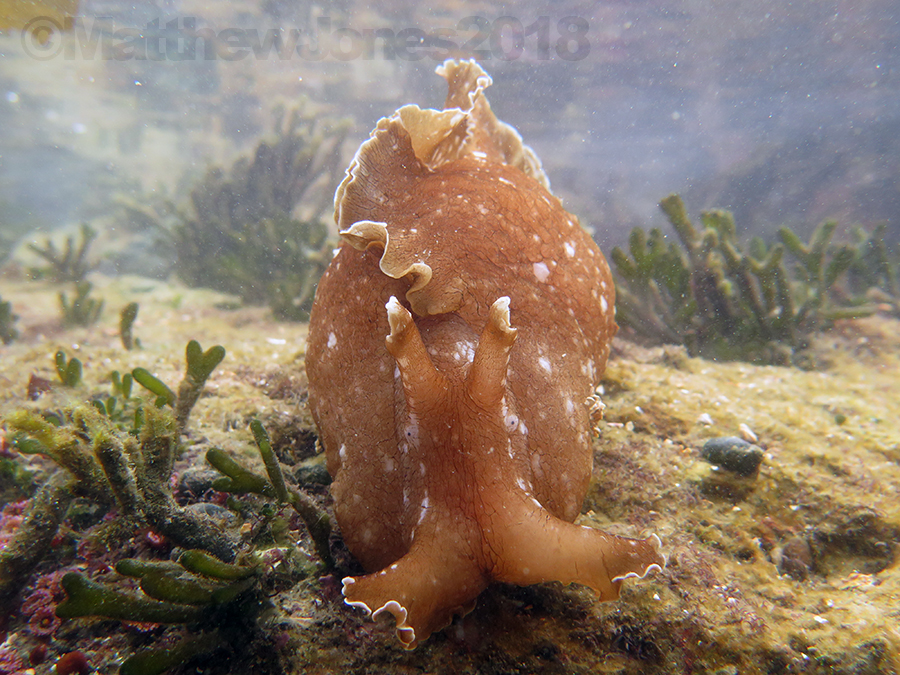
117 — Sea hare, Aplysia keraudreni

Aplysia keraudreni, Warrior Rocks,
Mt. Maunganui, July 2018.
Sea hares are large sea slugs which can reach sizes of up to half a metre in length. They get their name from a superficial appearance to actual hares. There are several species of sea hare found in New Zealand and although they are not considered to be rare, they tend to be what known as locally common. What this means is that if conditions are right you can get loads of them, but otherwise you won't see them at all.

Aplysia keraudreni Rang, 1928, is found in northern New Zealand and there is a similar species found in Australia. From what I can gather, sea hares (and particularly this species) are not that well-described, so it may turn out that this is a different species than previously thought. A. keraudreni has also been recorded from Chile and it is considered to have a south Pacific distribution (Medina et al., 2005; Uribe et al., 2013).
Aplysia keraudreni, Warrior Rocks,
Mt. Maunganui, July 2018.
Egg mass of A. keraudreni, Warrior Rocks,
Mt. Maunganui, July 2018.,
Aplysia keraudreni, expelling ink.

Once they reach adult size, sea hares don't appear to have many natural predators—but when they're disturbed can release clouds of toxic liquid. The colour of these inky clouds can go some way to helping identify the species: Aplysia keraudreni releases a purply-coloured ink, while the ink of A. dactylomela is wine-red coloured, and A. juliana doesn't release ink of any kind. The video below shows A. keraudreni expelling ink.

The sea hare pictured here (~25cm in length) was part of a mating pair and sea hares are known for forming-up into long chains of mating pairs. They then lay eggs in long gelatinous noodle-like structures, which can look a lot like a pile of instant noodles. However, if you look closely you can see the individual eggs.

The eggs hatch to release a tiny planktonic veliger larvae, which then live in the plankton for some time and then settle. This would also appear to be one part of sea hare biology that is not that well-known for many species.


More info

Sea slug forum: What are sea hares?

Medina, M., Collins, T., & Walsh, P. J. 2005. Phylogeny of sea hares in the Aplysia clade based on mitochondrial sequence DNA data. Bulletin of Marine Science 76(3), 691–698.

Uribe, R. A., Nakamura, K., Indacochea, A., Pacheco, A. S., Hooker, Y., & Schrödl, M. 2013. A review on the diversity and distribution of opisthobranch gastropods from Peru, with the addition of three new records. Spixiana, 36(1), 43–60. 

Willan, R. C., Morton, J. E. 1984. Marine molluscs part 2: Opisthobranchia. University of Auckland, Leigh Marine Laboratory, Leigh, New Zealand. 106 pp.

Saturday, 28 July 2018

116 — Oar brittle star, Ophiopteris antipodum

A short video of O. antipodum, Pilot Bay,
Mt. Maunganui, 17/7/18.
This is a very striking brittle star: deep purple in colour and with oar-like spiny projections on the arms—which is where they get their name.

Although Ophiopteris antipodum reaches sizes of ~10cm they're not often seen. This is not because they are particularly rare, but possibly because they live under rocks at and below low tide, so unless you're turning rocks and looking underneath, you're unlikely to see one. If you do find one, you'll quickly realise some things about them: they don't like light, will try and get away from it as fast as they can, and will do this quite rapidly.

They are found throughout New Zealand and are endemic. They seem to prefer sandy and/or rocky habitats down to depths >100m. It is thought that they feed on small invertebrates (Mills et al., 2017).

These ones came from Pilot Bay and Warrior Rocks, Mt. Maunganui, July 2018. They range in size between about 8 and 10cm across.

Ophiopteris antipodum, Pilot Bay,
Mt. Maunganui, 27/7/18


O. antipodum, Pilot Bay,
Mt. Maunganui, 27/7/18. This image is
lightened, so that the granular nature
of the disc can be seen.


O. antipodum, Pilot Bay,
Mt. Maunganui, 27/7/18. Underside of one of
the arms showing the salmon-coloured tube feet.

Ophiopteris antipodum, Pilot Bay,
Mt. Maunganui, 27/7/18.
The oral side of the brittle star.

O. antipodum, Pilot Bay, Mt. Maunganui, 17/7/18.
The underside of one of the arms
showing the salmon-coloured tube feet.


More info:

Mills et al. (2017). Extraordinary echinoderms. A guide to the echinoderms of New Zealand.


Sunday, 30 July 2017

115 — Miller's nudibranch, Phidiana milleri

Phidiana milleri, from under Ngapipi Bridge,
Tamaki Drive, central Auckland 15/6/18.
Phidiana milleri, from under Ngapipi Bridge,
Tamaki Drive, central Auckland 15/6/18.

Phidiana milleri, crawling in between
green-lipped mussels, the Gap, Piha, 2015,
(~30mm).
Phidiana milleri, crawling on red algae,
Lion Rock, Piha, 2017, (~10mm).
Phidiana milleri, from under Ngapipi Bridge,
Tamaki Drive, central Auckland 15/6/18,
(~30–40mm).
Miller's nudibranch, Phidiana milleri * is a small (to 42mm) and attractive sea slug endemic to New Zealand. It's named after Prof. Michael Miller, an expert in this field. It's reported be found in exposed clean water situations north of Banks Peninsula.
They are thought to feed on hydroids, possibly mussel's beard, which is neither a mussel, nor a beard, but a type of thecate hydroid called Amphisbetia bispinosa (Gray, 1843).
Willan & Miller (1984) considered this to be a commonly seen nudibranch, but this has not been my experience (maybe I'm looking in the wrong places). I've seen it a handful of times and mostly at Piha, on Auckland's west coast: crawling between green-lipped mussels (Perna canaliculus) at the Gap (where there were also hydroids), and then in a rock pool on Lion Rock, where a tiny juvenile was crawling on red algae. I've also seen it under Ngapipi Bridge on Auckland's Tamaki Drive, from under a rock adjacent to the bridge supports—another hydroid-rich habitat.

* Rudman, 1980


More info:

Sea slug forum: Phidiana milleri

Willan, R. C., Morton, J. E. 1984: Marine Molluscs Part 2: Opisthobranchia. University of Auckland, Leigh Marine Laboratory, Leigh, New Zealand. 106 pp.

Thursday, 25 May 2017

113 — Bioluminescence and camouflage in the deep-sea

Once you get down to 1000m in the ocean sunlight is gone, absorbed by the water above.

One thing I noticed during my doctoral research was that many of the fishes at this depth were drab shades of brown, some darker than others. If you live in a world of complete darkness why be brown? For that matter why be any colour at all, what evolutionary advantage could being brown give you?

Well the thing is—it’s not completely dark at these depths—far from it. There may no longer be any sunlight, but there is light from other sources. The world at 1000m is full of point-source bioluminescence, created by the animals that live there. Watch this great TED talk by marine scientist Edith Widder for a more detailed look at deep-sea bioluminescence.

If you’ve watched that talk, you may have noticed that most of the bioluminescence was light-bluish. Now the interesting thing here is that if you invert light blue: you show the colour not being reflected by that object, and that is brown.

What does this mean: If you are a brown fish in a world where the only light is bluish, then you are camouflaged against it, since brown absorbs blue.

Big-scaled slickhead (Alepocephalus australis),
northestern Chatham Rise, 1196m.

Big-scaled slickhead - inverted colour.

Baxter's dogfish (Etmopterus baxteri),
Puysegur Seamount, 1050m.

Baxter's dogfish - inverted colour.

Warty oreo, (Allocyttus verrucosus),
northeastern Chatham Rise, 901m.
~30cm total length (TL).

Warty oreo - inverted colour
The photos show a few examples of brown-coloured fishes and what they look like when the colour is inverted; that is, the colour they absorb.

Apologies for my dodgy 2004 photography. Thanks again to NIWA for providing the fishes.

Thursday, 18 May 2017

112 — Gruesome creatures live in the deep-sea…

I took a lot of pictures during my doctoral research, most of which I didn’t end up using for anything. Occasionally though, I would stumble upon something interesting, and by interesting I mean horrific.

A parasitic copepod attaching through the
body wall of a notable rattail.
Fish are often beset by parasites, not only internally, but also externally. Some of the external ones can be quite hideous. In this instance a notable rattail (Coelorinchus innotabilis, McCullock, 1907) has been attacked on its underside by a parasitic copepod. Copepods are crustaceans and these belong in the Order Siphonostomatoida and within that, probably the family Sphyriidae.

Sphyriid copepods attach through (yes, that’s through) the body wall of the fish by means of an anchored stalk and feed on the fish’s bodily fluids. The part you see on the outside is the body of the copepod and it’s reproductive parts ( ~1 cm). These particular copepod parasites are thought to only attack fishes that live close to the bottom and this feature can be used to ascertain details regarding the fish’s habits in lieu of other information. This was corroborated by the diet of this species, as notable rattails are bottom feeders (Jones 2008).

Notable rattail, NE Chatham Rise, 901m

Notable rattail, NE Chatham Rise, 901m.
Dorsal view.
Notable rattail, NE Chatham Rise, 901m.
Ventral view.
Don’t worry though, as these parasites don’t attack people (as far as I know). Plus, they tend to live in deep-water and if you happen to find yourself down at 1000m you probably have bigger problems.

As for the fish itself, rattails are ubiquitous in the deep-sea and about sixty species occur in New Zealand waters. Notable rattails live at an average depth of 985m (Anderson, et al. 1998), so most people won't have seen one. These came from a research trawl for orange roughy, which occurred on northeastern Chatham Rise, during July 2004 (Thanks go to NIWA).

Notable rattails feed on small invertebrates, which they pick from the sea bed (Jones, 2008). As such, they play an important role in the structuring of demersal (near the bottom) communities.


More info:

Anderson OF, Bagley NW, Hurst RJ, Francis MP, Clark MR, McMillan PJ 1998. Atlas of New Zealand fish and squid distributions from research bottom trawls. NIWA Technical Report 42.

Doonan IJ, Dunn MR, Dunford A, Hart AC, Tracey D 2006. Acoustic estimates of orange roughy abundance on the northeastern and eastern Chatham Rise, July 2004: wide-area and hill survey. New Zealand Fisheries Assessment Report 58.

Jones MRL 2008. Dietary analysis of Coryphaenoides serrulatus, C. subserrulatus and several other species of macrourid fish (Pisces: Macrouridae) from northeastern Chatham Rise, New Zealand. New Zealand Journal of Marine and Freshwater Research 42: 73–84.

Wednesday, 3 May 2017

111 — Wheel shell, Zethalia zelandica

Zethalia zelandica, north Piha Beach, 27/4/17.
These aren't that common here on the west coast. 
Zethalia zelandica, showing animal and
position in the sand. After Morton & Miller,
1968, p467.
The wheel shell, Zethalia zelandica, * is a small (~20 mm across), gastropod endemic to New Zealand and found throughout the three main islands. They are found off exposed sandy beaches and can wash up in great numbers after storms, particularly on the north eastern coast of North Island.

There are some morphological differences over their range, with examples from Stewart Island being higher in the spire and correspondingly narrower than those from the northeast of North Island. I can remember walking around the base of Mt. Maunganui as a boy and seeing banks of dead shells.

Wheel shells are thought to feed on diatoms and other organic matter; they do this through the ingestion of large amounts of sand, although their ecology isn't really all that well-known.

* (Hombron & Jacquinot, 1854)


More info:


Beu, A. G. & Maxwell, P. A. (1990). Revised descriptions of New Zealand Cenozoic Mollusca.

Morton, J. E. & Miller, M. (1968). The New Zealand seashore. Collins.

Saturday, 29 April 2017

110 — Sea slug, Alloiodoris lanuginata

Alloiodoris lanuginata, Warrior Rocks,
 Mt. Maunganui, 2017.
Alloiodoris lanuginata, with coil of eggs,
Warrior Rocks, Mt. Maunganui, 2017.
The sea slug Alloiodoris lanuginata (Abraham, 1877) is another species for which there is no common name. It's endemic to New Zealand's North Island and not particularly common. They are quite coarse to the touch and feel like they are covered in fine sand paper. This coarseness comes from fine spicules contained within tiny tubercles, which cover the dorsal surface of the sea slug.

Ecologically they prefer clean, but sheltered waters and are thought to feed on sponges. But, it's not known which species of sponge they prefer.

This one was found between boulders, on Warrior Rocks, at the base of Mt. Maunganui. It had just laid a coil of eggs. It's overall size was about 80mm, which is about as large as they get.

If I see another one I hope to get better pictures.


More info:

Sea Slug Forum: Alloiodoris lanuginata

Willan, R. C.,& Morton, J. E. (1984). Marine Molluscs part II - Opisthobranchia, pp. 1–106. University of Auckland, Leigh Marine Laboratory.


Thursday, 27 April 2017

109 — The rare sand chiton, Pseudotonicia cuneata

Pseudotonicia cuneata, The base of
Mt. Maunganui, Opposite Stony Point, 2017
Pseudotonicia cuneata, The base of
Mt. Maunganui, Opposite Stony Point, 2017
Pseudotonicia cuneata, The base of
Mt. Maunganui, Opposite Stony Point, 2017
There are a few dozen species of chitons (coat-of-mail shells) found on New Zealand coasts. However, as most of them could be considered to be unremarkable-looking, they aren't really noticed by your average beach-goer.
Many chitons are light-adverse and have light-sensing organs (ocelli) on their upper surface. They use these to orient themselves away from the light. As a consequence these species are often found under rocks or ledges. Most of the shallow water chitons are thought to be vegetarian grazers, feeding on algal films on hard surfaces. 
Pseudotonicia cuneata (Suter, 1907), is quite a rare and unusual chiton. It's found mostly around North Island and the top of South, at and below low tide down to a few metres deep.

What makes this chiton species unusual is that, unlike almost all other chitons, it's found in sand. But not just any sand, P. cuneata lives in areas with clean fast-flowing waters, but not those not open to wave action, and where there are also dead shells for it to attach to. These are conditions which aren't all that common, so as a consequence not many people have seen one.

It has been speculated that this species grazes on the algal films found on dead bivalve shells, as it's often found attached to them. However, this is another one of those species for which virtually nothing is known. These ones were about 40–50mm in length and from sand around the base of Mt. Maunganui during a spring low tide.

I've only ever found this species in length of beach about 10–20m long, so their habitat is quite vulnerable.


More info:


Ashby, E. (1928). The rediscovery of Tonicia cuneata Suter and Acanthochites thileniusi Thiele (Order Polyplacophora) together with the description of a new Genus and short review of the New Zealand Acanthochitonidae. Transactions and Proceedings of the Royal Society of New Zealand 1868–1961, 58, 392–607.

Powell, A.W.B. (1979). New Zealand Mollusca. Collins